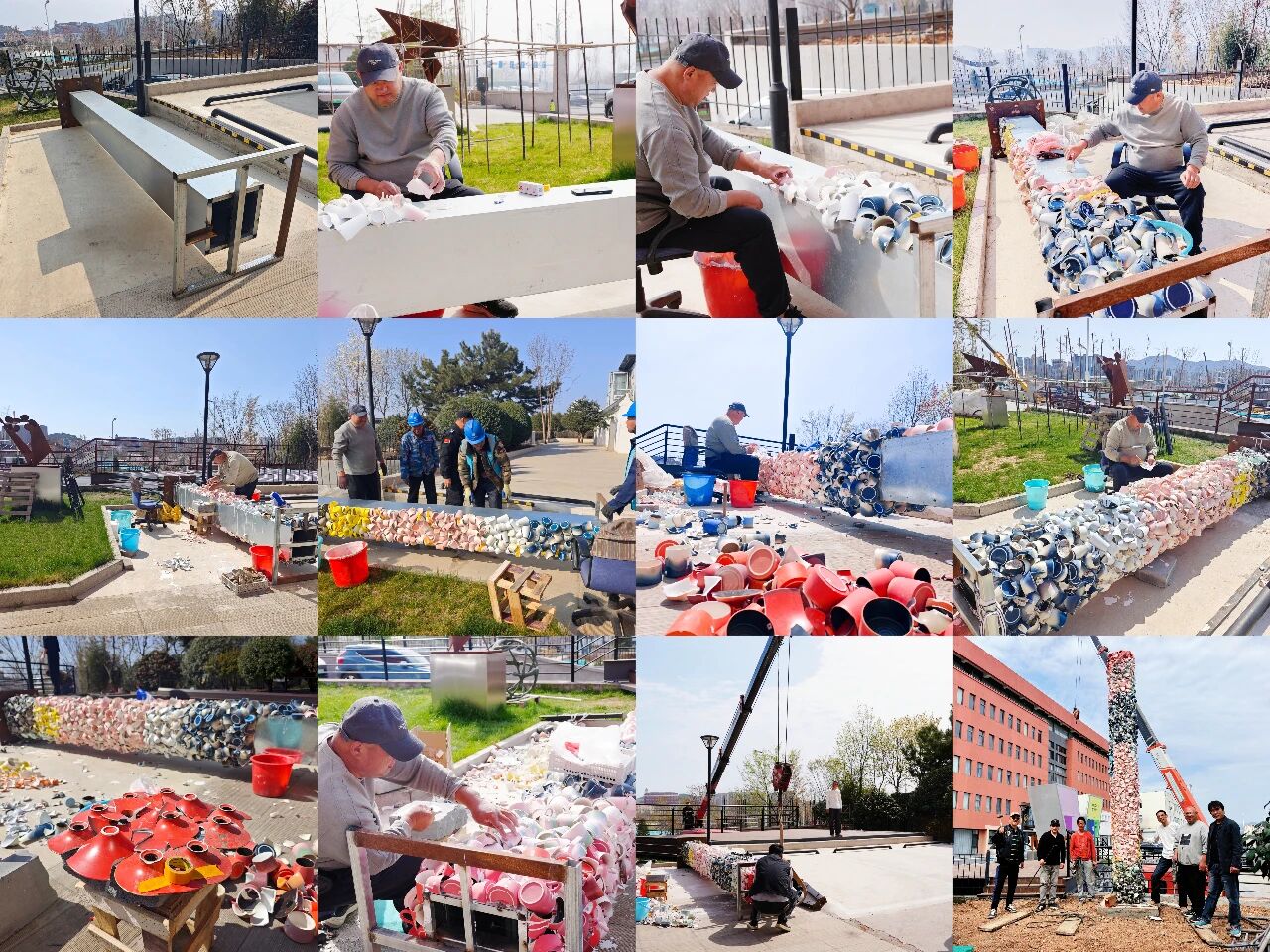
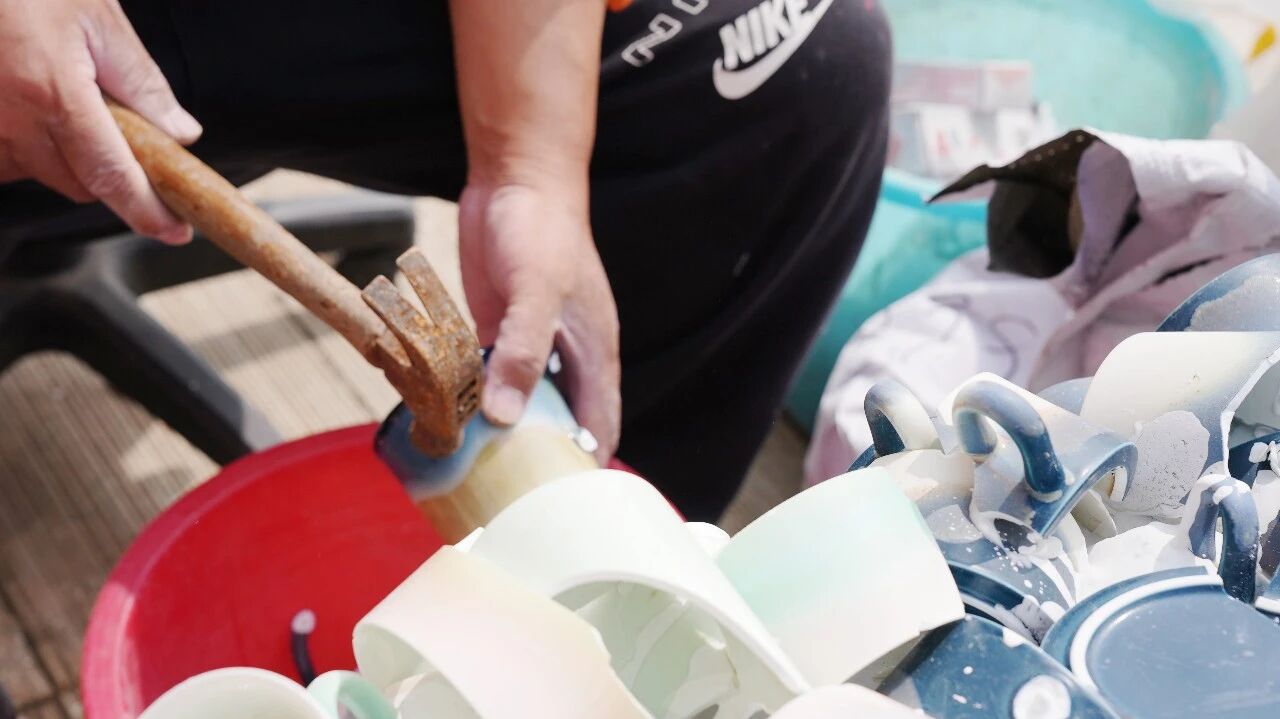
During his residency at the museum, artist Zhu Zhenhong employed the technique of his "Niè" series, blending fragments of coffee cups from Jingdezhen with shells collected from the beaches of Qingdao. Standing five meters tall, this piece is the tallest in his decade-long "Niè" series — like a totem pole of ascending colors.
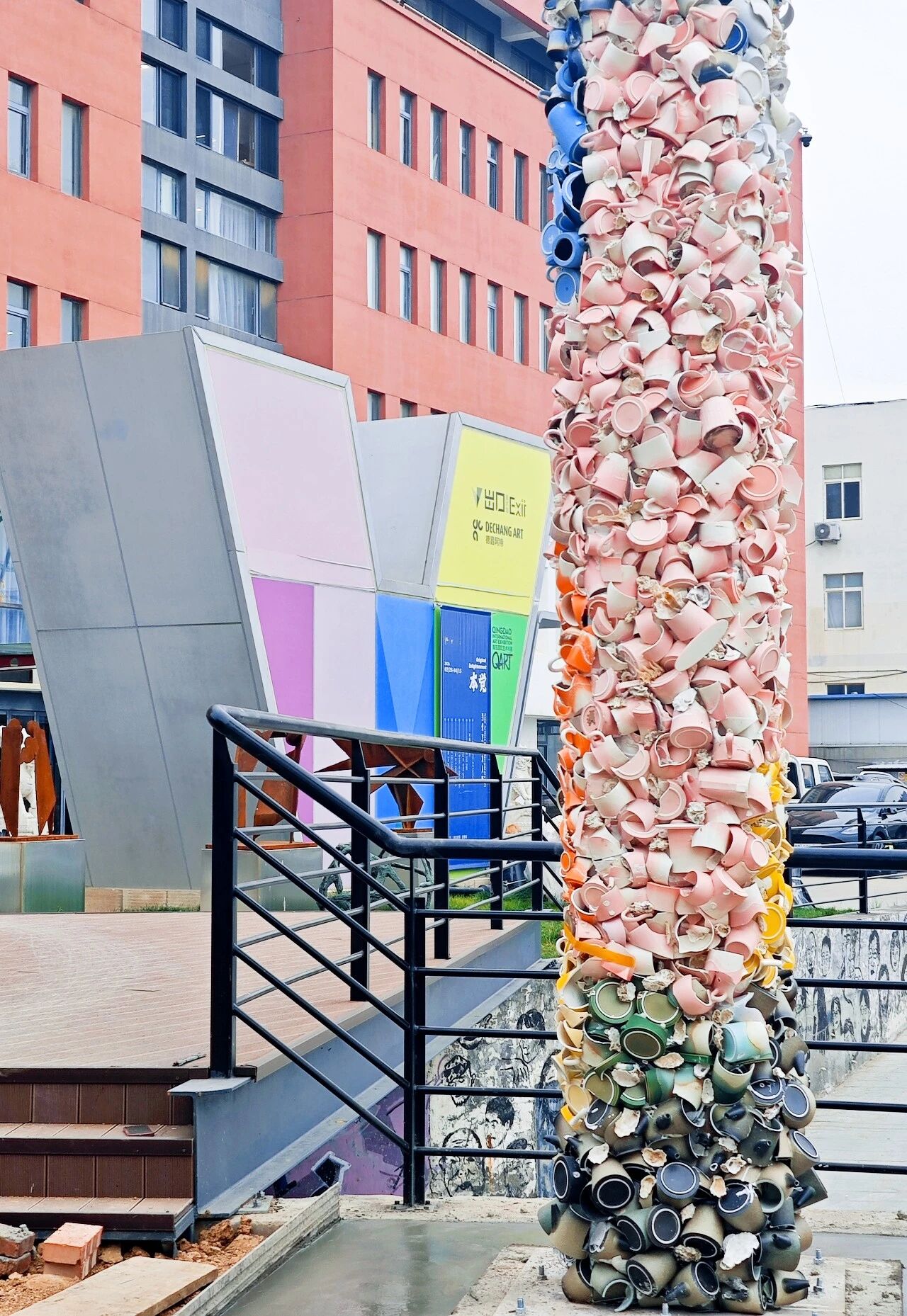
The Eastern memory of Jingdezhen porcelain fragments, the Western cultural symbols of coffee cups, and the local elements of Qingdao shells are shattered and reassembled. From Jingdezhen to Qingdao, from East to West, artist Zhu Zhenhong uses his work to reawaken the memory of the Maritime Silk Road.
In traditional Chinese understanding, ceramics represent the ultimate "utensil" — emphasizing completeness and perfection. However, in Zhu Zhenhong's hands, this "perfection" first encounters violent and direct destruction. Using the fragments of those ceramic coffee cups that we consider "useful," he completely dissolves the practical value and aesthetic conventions of ceramics as objects, returning them to their purest state of material and color. Thus, the physical utensils are elevated into a metaphysical spiritual totem.
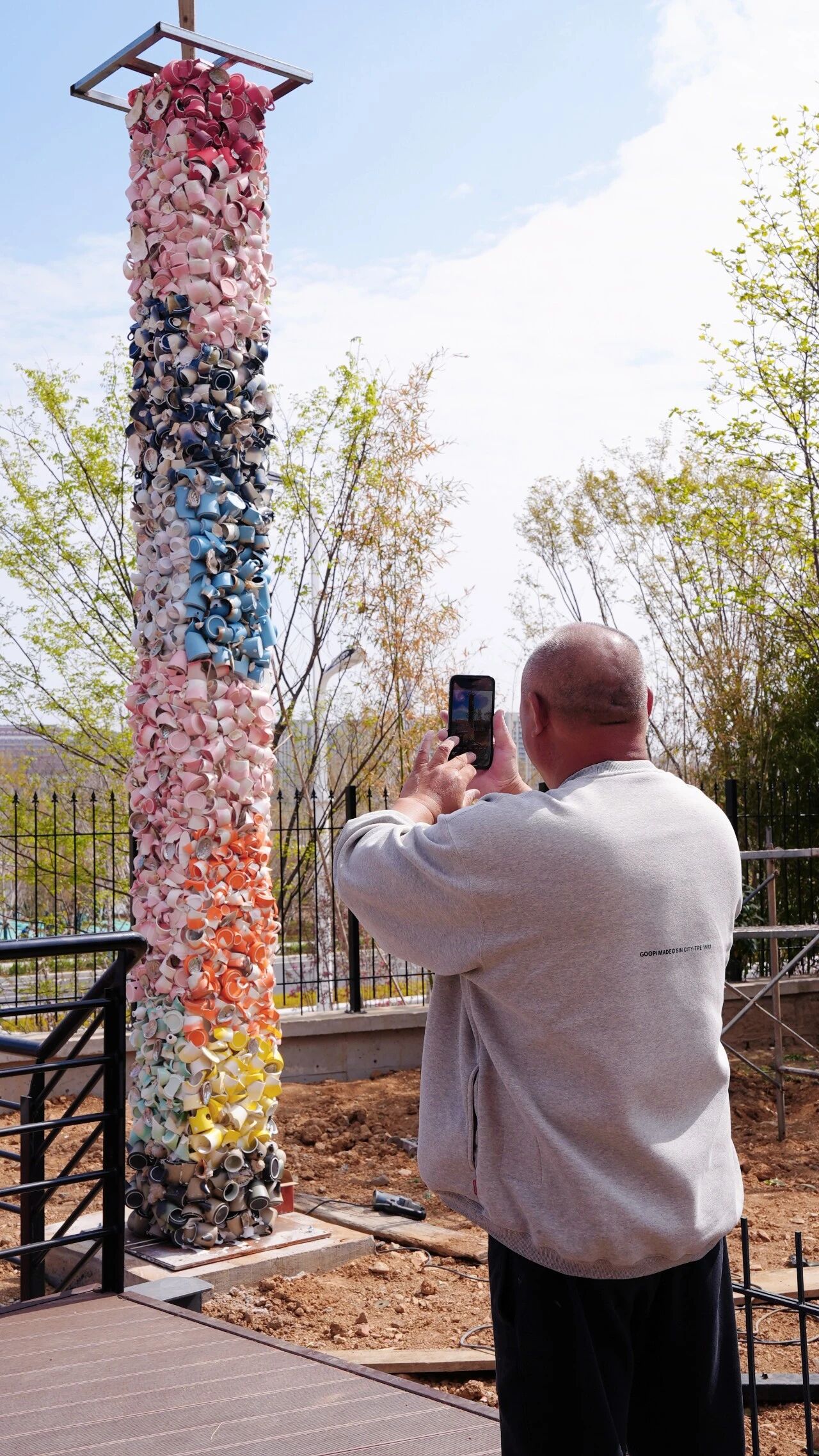
The day the work was completed happened to be the day Teacher Zhu was invited to depart. He set off from Qingdao for Venice, Italy, as an invited representative to attend the opening ceremony of the official special invitation exhibition of the 61st Venice Biennale, titled "Dawn in the East" (Asian Art Research Exhibition). This work carries not only a local residency creation but also the beginning of an international art narrative. Using shattered porcelain as pigment and the shipwreck as metaphor, it tells not the story of any single region, but the universal proposition of civilization's continuous dialogue through fracture and rebirth.
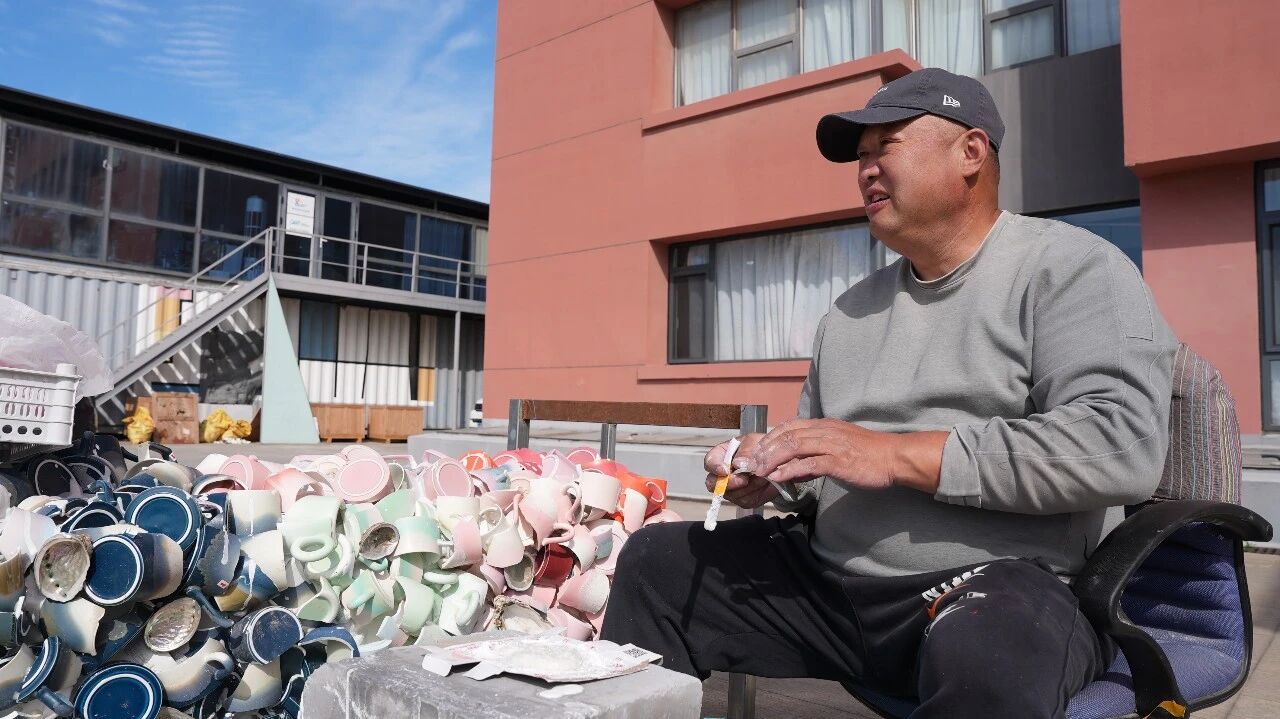
Zhu Zhenhong, born in 1973 in Yinan, Shandong Province, is a freelance artist.
He has long focused on high-temperature color glaze as his core medium, expanding into overglaze painting, mixed media, ready-mades, installations, and other diverse forms. His work explores the uncertainty of glaze transformations, the tension of color, and the contemporary reinterpretation of materiality, forming a unique aesthetic system of material expression.
Selected Solo Exhibitions:
Manet Grass International Art Center, Beijing (2016); Powerlong Museum, Shanghai (2018); Trump International Hotel & Tower, Vancouver (2017); Art Museum of Jingdezhen Ceramic University (2022); DCA · Exit V Art Museum (2024, 2025).
Awards and Honors:
His work was selected for the "Spirit of Porcelain – Jingdezhen International Ceramic Art Biennale" (2022) and received the Jinyitao Award. He also won the Gold Award in the first "China Collection – My Favorite Ceramic Artwork" competition (2012).